How to Select Safety Tilt Switches for Smart Home Appliances? An Analysis of Tilt Detection Accuracy and NO/NC Output
2026-10-09
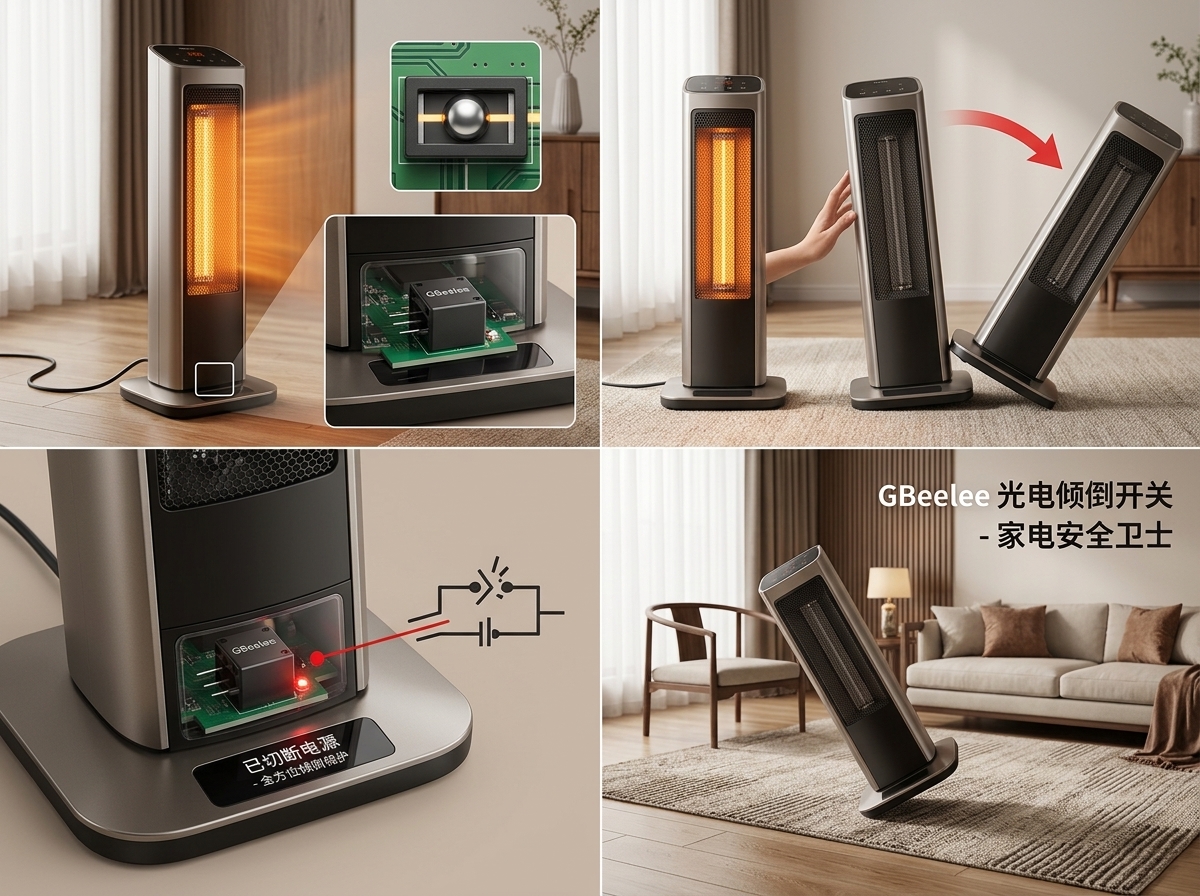
Engineers developing products like fan heaters, electric radiators, and tower fans often encounter a common issue: a tilt switch performs perfectly during prototype testing but triggers frequent false alarms once in the user's home. Investigation reveals the problem lies in the specified trigger angle—nominally 15°—where actual units in a batch might trigger at 10° or only react at 20°. Such batch-to-batch inconsistency is difficult to control with mechanical switches.
As we approach 2026, safety standards for home appliances are imposing increasingly strict requirements on the response speed and reliability of anti-tip protection. Photoelectric tilt switches—offering advantages such as non-contact detection, immunity to contact oxidation, long service life, and high precision—are gradually replacing traditional mechanical ball-type solutions. However, when selecting a switch, two key factors—tilt detection accuracy and the output configuration (Normally Open/Normally Closed)—directly determine the device's safety.
As we approach 2026, safety standards for home appliances are imposing increasingly strict requirements on the response speed and reliability of anti-tip protection. Photoelectric tilt switches—offering advantages such as non-contact detection, immunity to contact oxidation, long service life, and high precision—are gradually replacing traditional mechanical ball-type solutions. However, when selecting a switch, two key factors—tilt detection accuracy and the output configuration (Normally Open/Normally Closed)—directly determine the device's safety.
1. Tilt Detection Accuracy: Trigger Angle Deviation Determines Reliability
Tilt detection accuracy is the most critical specification for photoelectric tilt switches; it directly determines whether the device triggers power-off protection at the correct angle. Insufficient accuracy leads to problems—either failing to cut power when necessary or cutting power when it shouldn't.
Common trigger angle specifications include 10°, 15°, 20°, 25°, 30°, and 45°. Anti-tip protection for home appliances typically requires a range of 15°–30°; robot vacuums climbing slopes need 10°–15°; and precision leveling requires 3°–10°. It is advisable to allow a margin of 2°–5° during selection. This is because trigger angles vary within a batch—mechanical switches often have a tolerance of ±5°, which can cause frequent false alarms if a fan heater is placed on a slightly sloped floor during mass production, whereas photoelectric switches can maintain a tolerance within ±1°.
Accuracy is reflected not only in the initial value but also in long-term stability. Mechanical switches are susceptible to spring fatigue and contact oxidation, causing the trigger angle to drift over time. Photoelectric sensors utilize non-contact detection; since the oxidation of metal components does not affect performance, they offer superior stability in terms of both lifespan and accuracy.
Photoelectric tilt switches typically offer both Normally Open (NO) and Normally Closed (NC) output options. For tip-over protection, the Normally Closed (NC) output is recommended because it supports "wire-break detection": if the connection between the switch and the controller is severed, the controller detects an open circuit and triggers the power-off safety mechanism. In contrast, a Normally Open (NO) output cannot signal an alarm if the wire breaks, posing a safety risk. Common pitfalls during selection include overlooking how the output type affects safety logic—some applications require a "fail-safe" (power-off) state, making NC the only logical choice; mismatches between the output level (NPN vs. PNP) and the main controller preventing signal recognition; and failing to consider the added safety provided by wire-break detection.
Tilt detection accuracy is the most critical specification for photoelectric tilt switches; it directly determines whether the device triggers power-off protection at the correct angle. Insufficient accuracy leads to problems—either failing to cut power when necessary or cutting power when it shouldn't.
Common trigger angle specifications include 10°, 15°, 20°, 25°, 30°, and 45°. Anti-tip protection for home appliances typically requires a range of 15°–30°; robot vacuums climbing slopes need 10°–15°; and precision leveling requires 3°–10°. It is advisable to allow a margin of 2°–5° during selection. This is because trigger angles vary within a batch—mechanical switches often have a tolerance of ±5°, which can cause frequent false alarms if a fan heater is placed on a slightly sloped floor during mass production, whereas photoelectric switches can maintain a tolerance within ±1°.
Accuracy is reflected not only in the initial value but also in long-term stability. Mechanical switches are susceptible to spring fatigue and contact oxidation, causing the trigger angle to drift over time. Photoelectric sensors utilize non-contact detection; since the oxidation of metal components does not affect performance, they offer superior stability in terms of both lifespan and accuracy.
Photoelectric tilt switches typically offer both Normally Open (NO) and Normally Closed (NC) output options. For tip-over protection, the Normally Closed (NC) output is recommended because it supports "wire-break detection": if the connection between the switch and the controller is severed, the controller detects an open circuit and triggers the power-off safety mechanism. In contrast, a Normally Open (NO) output cannot signal an alarm if the wire breaks, posing a safety risk. Common pitfalls during selection include overlooking how the output type affects safety logic—some applications require a "fail-safe" (power-off) state, making NC the only logical choice; mismatches between the output level (NPN vs. PNP) and the main controller preventing signal recognition; and failing to consider the added safety provided by wire-break detection.
2. Key considerations for selection
Step 1: Determine the trigger angle. Requirements vary by appliance type—fan heaters and electric heaters usually require 15°–30°, while robot vacuums need 10°–15°. Regarding accuracy, if high reliability is required, opt for the photoelectric type; the ±5° tolerance of mechanical switches is difficult to control during mass production.
Step 2: Choose between Normally Closed (NC) and Normally Open (NO) outputs. NC is recommended for tip-over protection due to its higher safety redundancy. Also, ensure the output level (NPN/PNP) is compatible with the main control chip.
Step 3: Consider the operating environment. Is it indoors or outdoors? Is there vibration? Is waterproofing or dustproofing required? Fully sealed packaging is mandatory for outdoor or humid environments.
Step 4: Request samples for actual testing. Install three to five samples into the complete unit and test tilting in various directions to verify trigger angle consistency and hysteresis stability; do not draw conclusions based on testing a single sample.
Step 5: Evaluate the manufacturer's level of cooperation. Do they accommodate non-standard dimensions? What is the lead time for samples? How quickly do they respond to technical support requests? In real-world projects, these factors are often more important than the technical specifications themselves.
Conclusion
Selecting a photoelectric tilt switch ultimately comes down to balancing tilt detection accuracy with the required output configuration (Normally Open or Normally Closed). Bailing Electronics offers switches with a trigger angle error controlled within ±1° and an operational lifespan exceeding 1 million cycles; they support 360° omnidirectional tilt detection, triggering a signal to the MCU control circuit when the tilt exceeds the preset angle. Regarding output configurations, NPN/PNP options are available, and the Normally Closed output includes a wire-break detection function, making it ideal for anti-tip protection in smart home appliances. Customization options include an operating temperature range of -40°C to +125°C and IP67/IP68 protection ratings, with a 1–3 day turnaround for evaluation and a 2–3 week lead time for samples. To select the most suitable model, one should consider the specific product form factor and operating environment, while verifying trigger angle consistency and hysteresis stability through actual sample testing.
Selecting a photoelectric tilt switch ultimately comes down to balancing tilt detection accuracy with the required output configuration (Normally Open or Normally Closed). Bailing Electronics offers switches with a trigger angle error controlled within ±1° and an operational lifespan exceeding 1 million cycles; they support 360° omnidirectional tilt detection, triggering a signal to the MCU control circuit when the tilt exceeds the preset angle. Regarding output configurations, NPN/PNP options are available, and the Normally Closed output includes a wire-break detection function, making it ideal for anti-tip protection in smart home appliances. Customization options include an operating temperature range of -40°C to +125°C and IP67/IP68 protection ratings, with a 1–3 day turnaround for evaluation and a 2–3 week lead time for samples. To select the most suitable model, one should consider the specific product form factor and operating environment, while verifying trigger angle consistency and hysteresis stability through actual sample testing.
Safety and efficiency of photoelectric liquid level switches in liquid level monitoring applications in the home appliance industry
Related Article
Safety and efficiency of photoelectric liquid level switches in liquid level monitoring applications in the home appliance industry

Gas is an important substance for human survival, and it is also a raw material and product in many industrial productions. As long as there is a detection box control requirement for the temperature, humidity, pressure, flow, and concentration of the gas, the relevant equipment and systems need to be equipped with corresponding gas sensors.
What is Gas Sensor
As a basic and key sensing technology, reed switches will play an increasingly important role in the future intelligent era. From homes to industries, from medical care to transportation, the application of magnetic reed switches will run through various fields, promoting technological innovation and social progress.
Reed switch: the source of perception leading the intelligent era